

If you’ve ever received an HVAC estimate and quietly wondered whether the new air conditioner comes with a small vacation home attached, you’re not alone.
HVAC is one of those things most homeowners and tenants barely think about—until the house is 87 degrees, the air coming out of the vents isn’t cold, and suddenly everybody in the family has become an expert in compressors.
For property owners, there’s another layer:
How do you know when an HVAC repair is legitimate, when replacement makes sense, and what you can do to keep the system running well in the first place?
For this edition of MPM Resources, we sat down with Zuhair, owner of Valencia Air in Santa Clarita, for what turned into a very candid HVAC crash course.
And the thing we appreciated most wasn't a particular brand recommendation, piece of equipment or sales pitch.
It was his approach.
Character Is Part of the Transaction
There is an easy way to sound knowledgeable in almost any service business:
Explain why everyone else is doing it wrong.
That's not what impressed us about Zuhair.
What stood out was how comfortable he was with homeowners asking questions, comparing options and even getting other estimates.
In fact, he encourages it.
His advice was essentially: Please get three estimates. That's due diligence. It's what I would do if I were you.
Then compare what you're actually being offered.
That distinction matters.
Because when someone is standing in your home explaining that you may need to spend thousands—or sometimes tens of thousands—of dollars, you aren't only buying equipment.
You're buying someone's judgment.
And judgment is a lot more valuable when the person giving it isn't afraid of you asking questions.
Zuhair talked repeatedly about educating the customer, giving them control over the decision, and explaining why he recommends one solution over another.
Sometimes that recommendation is replacement.
Sometimes it's repair.
Sometimes it's a smaller solution to a very specific problem.
And sometimes it's simply:
You don't need that.
We like that.
A contractor shouldn't have to convince you that everybody else is wrong in order for you to trust his recommendation.
A good one should be able to say:
Here's what I see. Here's what I would do and here's why. Now go make the decision that's right for you.
That kind of integrity is difficult to put on an estimate.
But we'd argue it's one of the most valuable things you're buying.
Before You Call the HVAC Company, Do These Things
One of our favorite parts of the conversation was realizing how many HVAC problems can be made better—or considerably worse—by a few very ordinary household habits.
Zuhair gave us several tips that homeowners and tenants can put into practice immediately. No toolbox required.
1. Don't Turn the AC Completely Off Every Time You Leave
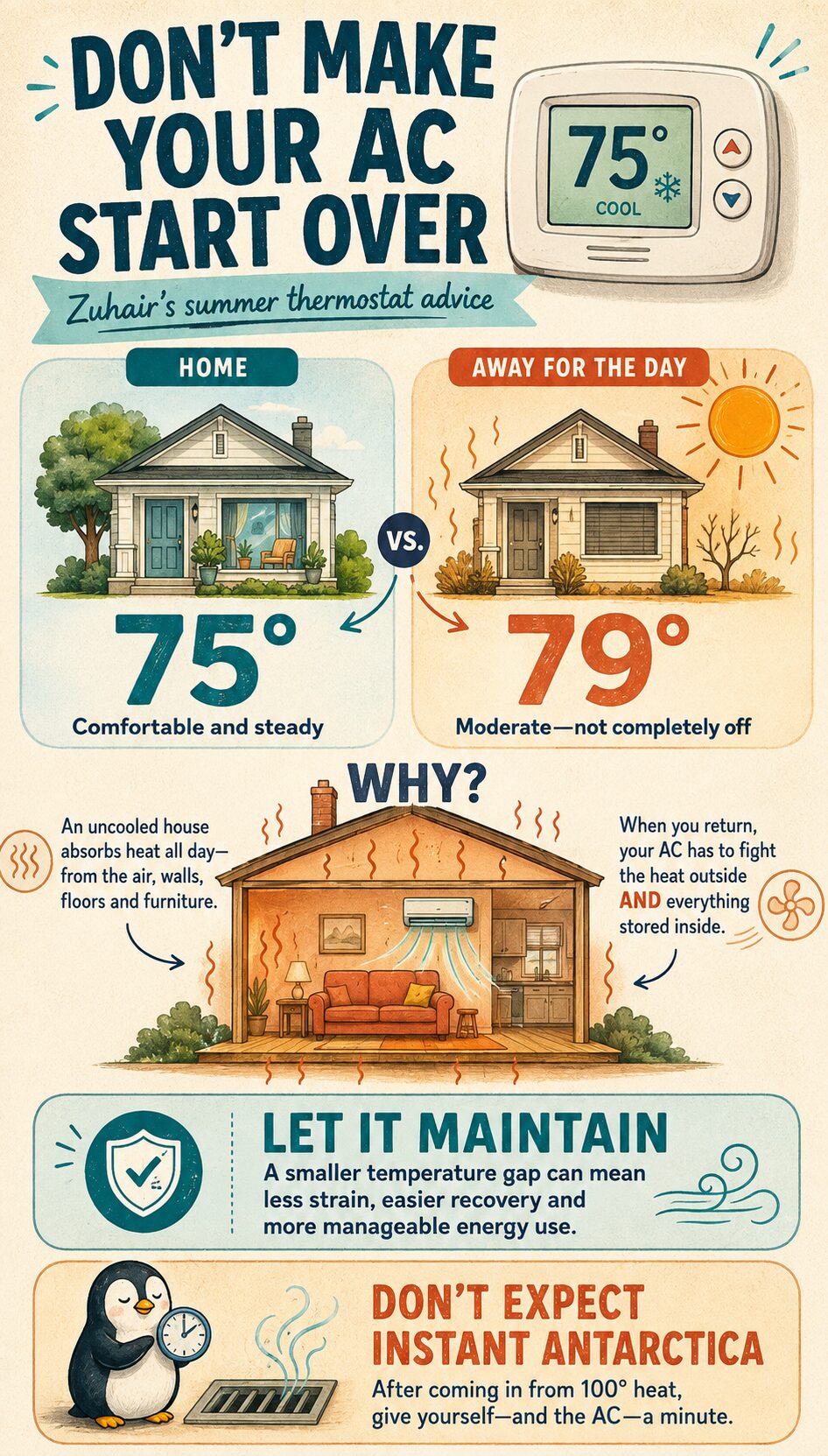
Zuhair's general summer recommendation is to keep the thermostat around:
75° when you're home and approximately 79° when you're away for the day.
Why cool an empty house?
Because you aren't really trying to keep the empty house comfortable. You're trying to prevent the entire structure from becoming a heat-soaked box.
If the AC is completely off during a hot Santa Clarita day, the indoor temperature can climb significantly.
Then you walk in at 5:30, discover that your living room has become a convection oven, set the thermostat to 68 and expect an immediate miracle.
Your air conditioner would like a word.
Now the system has to fight the heat outside and all the heat that has accumulated inside the home.
Keeping the house at a more moderate temperature while you're gone gives the system a much smaller gap to recover when you return. Zuhair says that can mean less strain on the equipment as well as more manageable energy use - resulting in a lower electricity bill.
If you're leaving for an extended trip, that's different. But for a normal workday, his advice is to let the system maintain rather than making it start over every afternoon.
And don't expect instant Antarctica
There's also a human element here.
When you walk inside after being out in 95- or 100-degree weather, you're hot.
Your body needs a little time to adjust.
A 78-degree room can feel pretty fantastic after you've been standing in a Santa Clarita parking lot in August.
Give both yourself and the AC a minute before declaring an emergency.
2. Change. Your. Air. Filter.
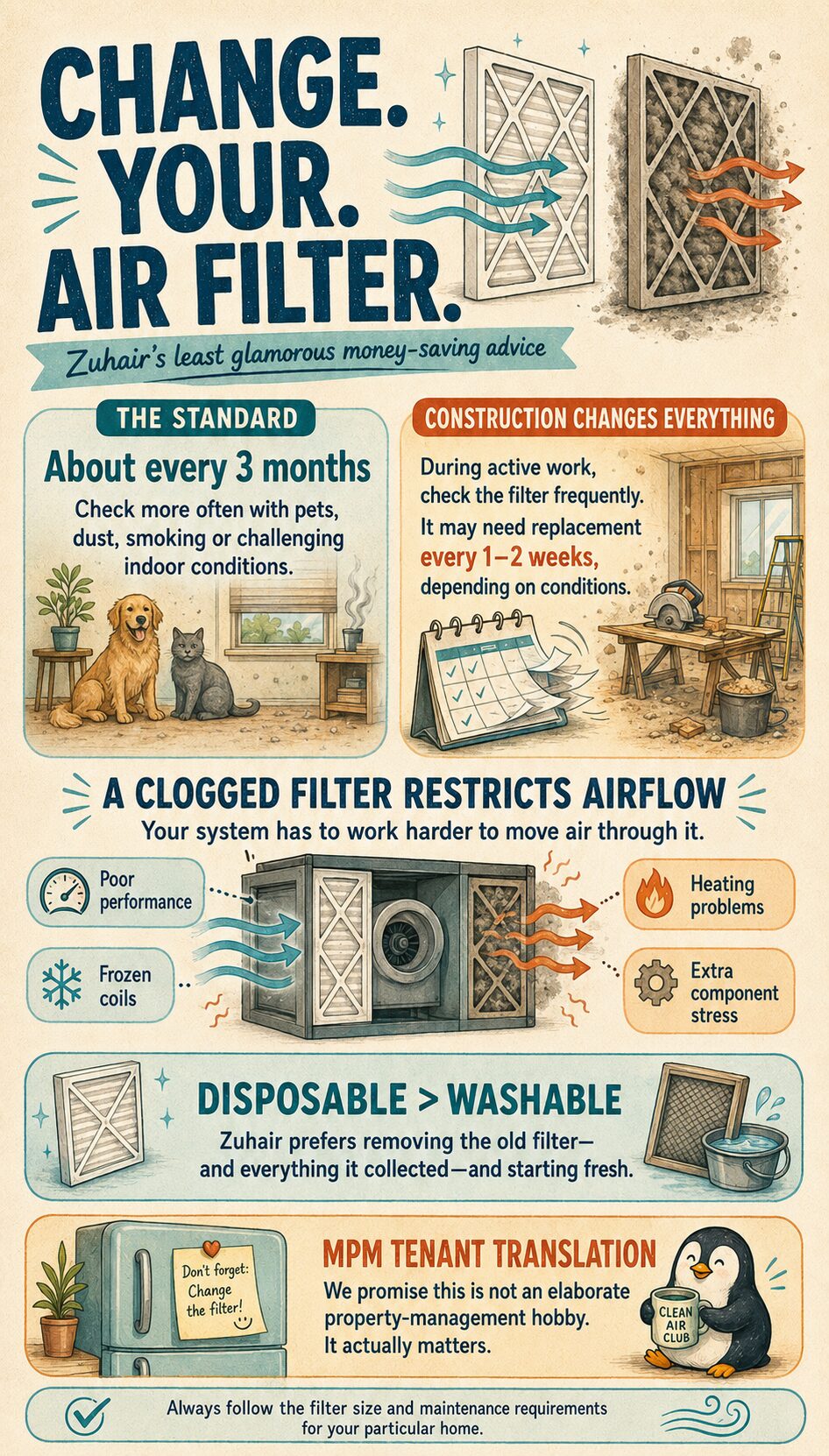
If Zuhair could put one HVAC reminder on every refrigerator in Santa Clarita, we're pretty sure it would be this:
Change the filter.
His standard recommendation is roughly every three months.
Some homes need it more frequently depending on pets, dust, smoking, the location of the return and the conditions inside the home.
And if construction is happening inside the house?
Forget the normal schedule.
Construction dust can clog a filter extremely quickly, so during active work the filter may need to be checked and replaced as frequently as every week or two depending on conditions.
Why does such a simple thing matter?
Because an HVAC system has to move a tremendous amount of air.
When the filter gets clogged, the system has to work harder to pull air through it.
That restriction can contribute to poor performance, frozen coils, heating problems and additional stress on components.
Zuhair sees service calls that begin with something as ordinary as a neglected filter and end with considerably more expensive repairs.
Which makes the filter perhaps the least glamorous financial investment in your home.
It may also be one of the better ones.
MPM tenant translation: If we're asking you to change your filter, we promise this is not an elaborate property-management hobby we've developed.
It actually matters.
What about washable filters?
Zuhair strongly prefers disposable replacement filters rather than washable filters. His recommendation is to remove the entire old filter—and everything it has collected—and start fresh.
For an MPM-managed home, tenants should always follow the filter specifications and maintenance requirements for their particular property.
3. Please Stop Closing All the Vents
This one surprised us.
The logic seems perfectly reasonable:
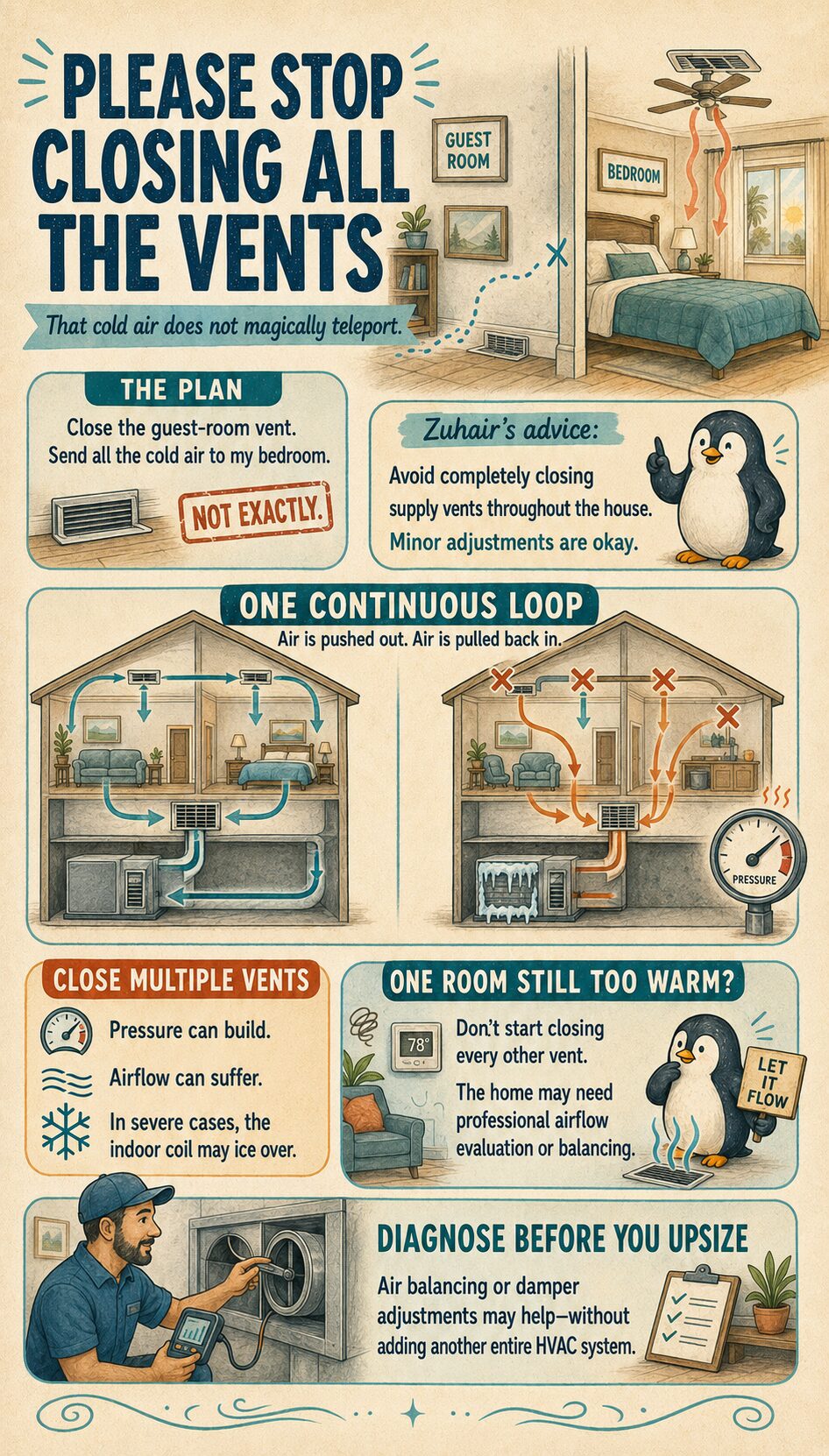
We never use the guest room. I'll close that vent and all the cold air will magically go to my bedroom.
Not exactly.
Zuhair's advice is to avoid completely closing supply vents throughout the house.
You can make minor adjustments, but shutting multiple vents can disrupt the amount of air the system was designed to move.
Think of the HVAC system as one continuous circulation loop.
Air is pushed out.
Air is pulled back in.
When you dramatically restrict one part of that process, pressure builds and airflow suffers.
In more severe situations, improper airflow can even contribute to the indoor coil icing over.
So if one bedroom refuses to cool while the rest of the house feels fine, the answer isn't necessarily to start shutting vents everywhere else.
The home may need professional airflow evaluation or balancing.
And that's another thing we liked about Zuhair's approach: diagnose the actual problem before selling a larger solution.
In one discussion about poor upstairs airflow, he explained that air balancing or damper adjustments could potentially improve the situation without adding another entire HVAC system.
4. If It's Blowing Air but the Air Isn't Cold, Look Outside
Here's an easy troubleshooting step that doesn't require you to become an HVAC technician.
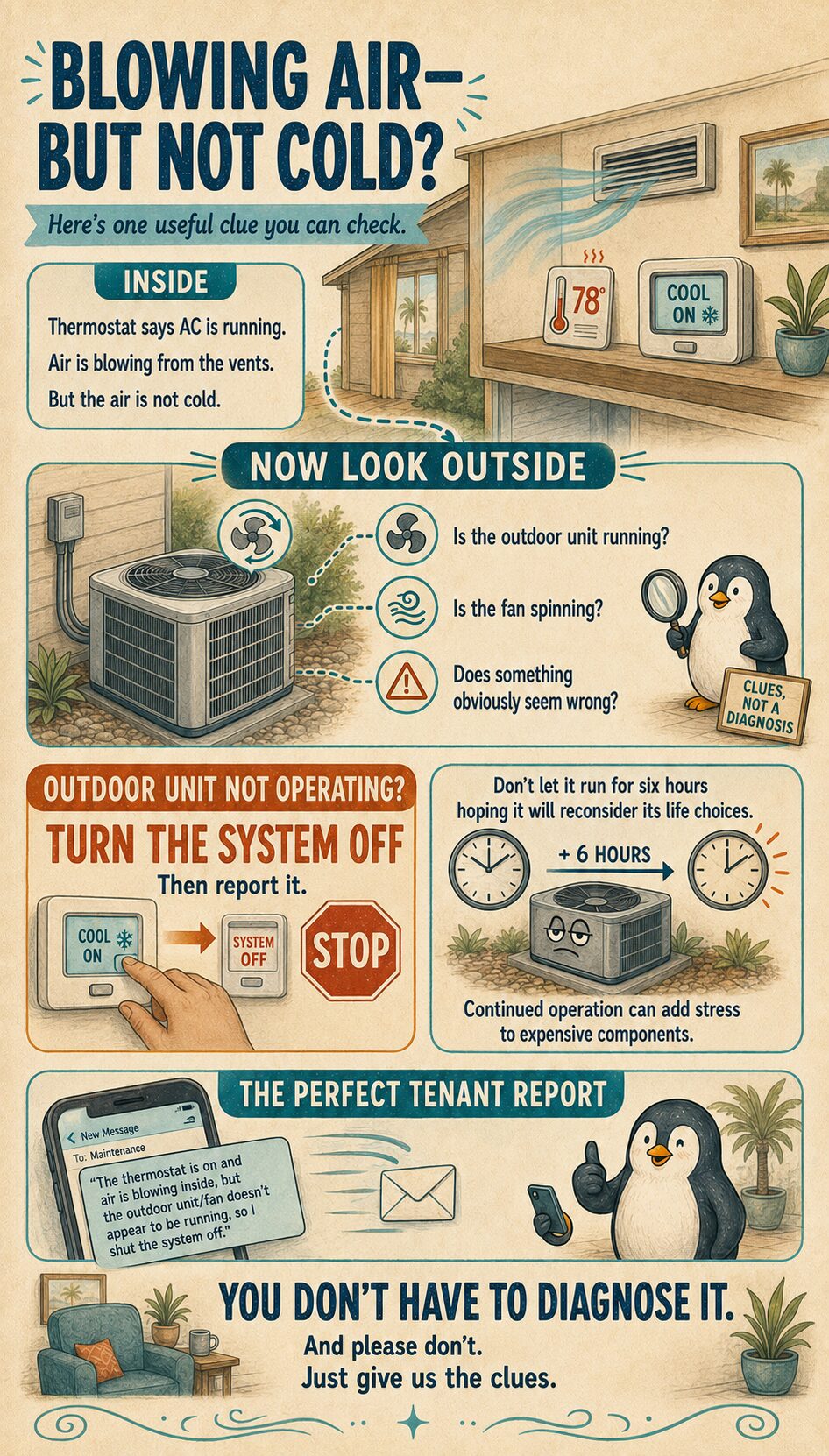
If your thermostat says the AC is running and air is blowing from the vents—but the air isn't cold—take a look at the outdoor unit.
Is it running?
Is the fan spinning?
Does something obviously seem wrong?
If the inside system is blowing but the outdoor equipment isn't operating properly, turn the system off and report it.
Don't let it run for six hours in the hope that it will eventually reconsider its life choices.
Continuing to operate a malfunctioning system can put additional stress on expensive components and potentially turn a relatively manageable repair into a much larger one.
For tenants, this is incredibly helpful information to give us:
“The thermostat is on and air is blowing inside, but the outdoor unit/fan doesn't appear to be running, so I shut the system off.”
Perfect.
You don't have to diagnose it - and please don’t.
Just give us the clues.
Repair or Replace? Beware of the Automatic Answer
Eventually almost every HVAC system creates the same uncomfortable question:
Do we repair this thing one more time, or are we throwing good money after bad?
There isn't a universal answer.
And this was another place where Zuhair's approach stood out.
During our conversation, we discussed an approximately 20-year-old system that was still working.
His immediate response wasn't:
Twenty years old? Replace it.
It was essentially:
If it's working, maintain it. Let's first figure out what problem you're actually trying to solve.
In that particular situation, the main complaint involved specific rooms that weren't cooling well. Zuhair suggested looking at more targeted solutions rather than replacing a whole functioning central system simply because it was old.
That's the kind of advice that earns trust.
Because “this equipment is old” and “you need to spend $15,000 today” are two entirely different statements.
On the other hand, there comes a point where repeated repairs stop making financial sense.
Zuhair recommends looking at the history of the system, not merely today's invoice.
If you've had several significant repairs within a short period, you're spending thousands of dollars on equipment that is still old when the repair is finished.
At some point, replacement becomes the more responsible financial choice.
For a rental-property owner, there's another expense that's harder to quantify:
disruption.
Repeated failures mean emergency calls, unhappy tenants, appointment coordination, access issues, hotel conversations, maintenance follow-up and management time.
The cheapest decision today isn't always the least expensive decision over five years.
5. Don't Buy a Whole New HVAC System to Fix One Hot Bedroom
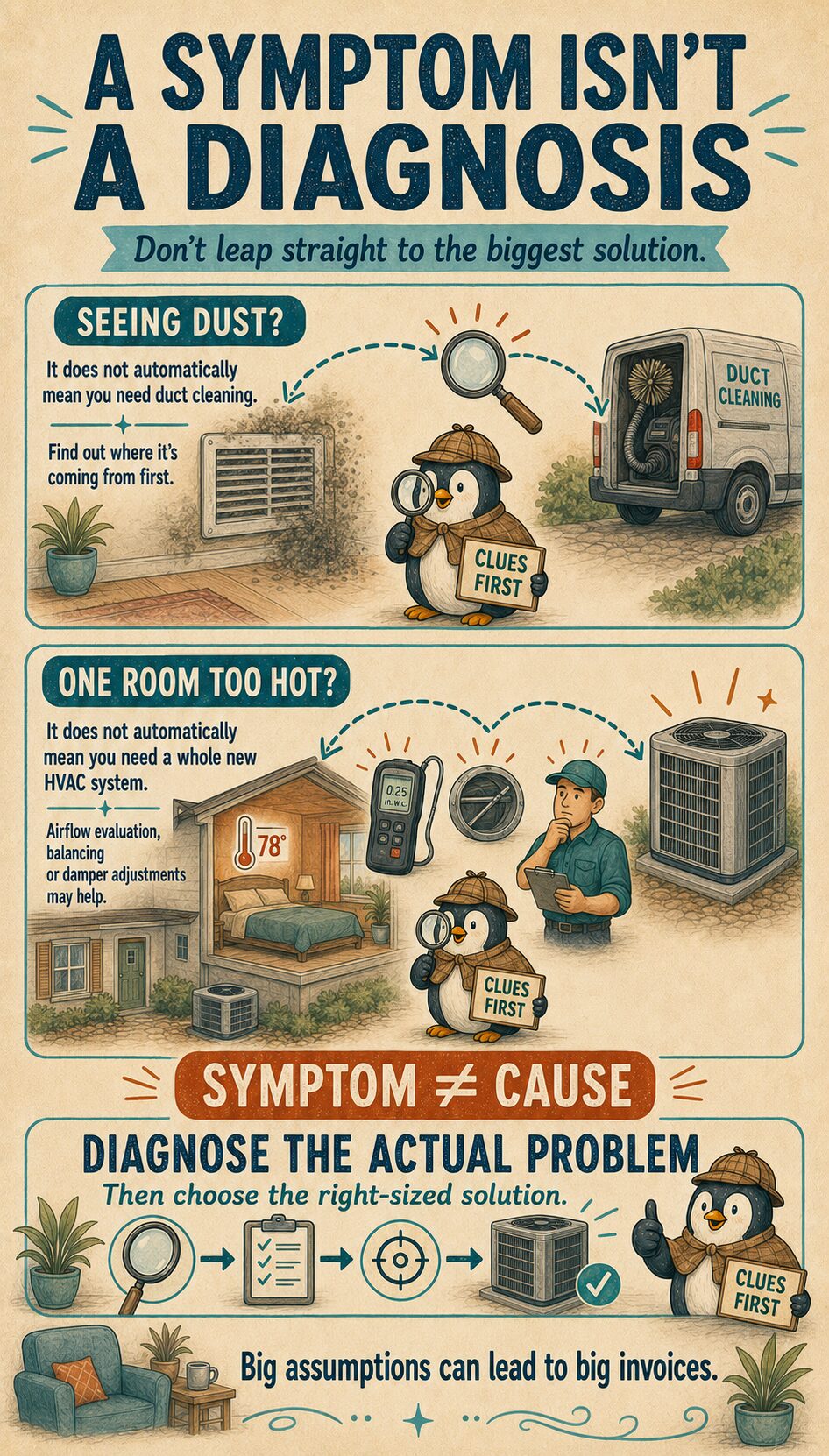
There's a broader lesson here that applies well beyond heating and air conditioning:
Solve the problem you actually have.
A hot room might be caused by airflow. Ductwork. Balancing. The home's layout. Equipment location. Or something else entirely.
For certain homes, a ductless mini-split may also be an option.
These systems can provide heating and cooling to a particular bedroom, office, garage, addition or other difficult area without requiring the homeowner to operate or redesign an entire central system.
Does that mean everyone should run out and buy a mini-split?
Absolutely not.
That's almost the opposite of the point.
The point is that a good contractor should investigate why you aren't comfortable before telling you what to buy.
What About All That Dust?
If your furniture seems to grow a new layer of dust eleven minutes after you clean it, your first instinct may be:
The ducts are dirty. We need them cleaned.
Maybe.
But Zuhair cautions against jumping immediately to that conclusion.
Your HVAC system continually moves air through the house. If there are leaks or poorly sealed areas around the return side of the equipment, that system may also pull dust and unfiltered air from places it shouldn't.
That's known as air infiltration.
Attic openings and other gaps in the home's envelope can contribute as well.
So a dusty house doesn't automatically equal dirty ducts.
It means:
Find out where the dust is coming from.
And No, Every House Does Not Automatically Need Duct Cleaning
This may have been one of our favorite answers of the entire conversation.
Should homeowners clean their ductwork?
Zuhair's answer was essentially:
It depends.
Which isn't nearly as exciting as “Absolutely! Everyone needs this $2,000 service!”
But it's much more useful.
The age and condition of the ductwork matter.
The filtration matters.
The home matters.
Sometimes cleaning makes sense.
Sometimes an inspection shows that it isn't necessary.
And with very old ductwork, it may make more sense to evaluate replacement rather than putting significant money into cleaning aging material.
Zuhair doesn't perform duct cleaning himself. He refers that work to a company that specializes in it.
We appreciate that too.
A good professional doesn't have to personally sell every solution to be helpful.
6. So How Should You Compare HVAC Estimates?
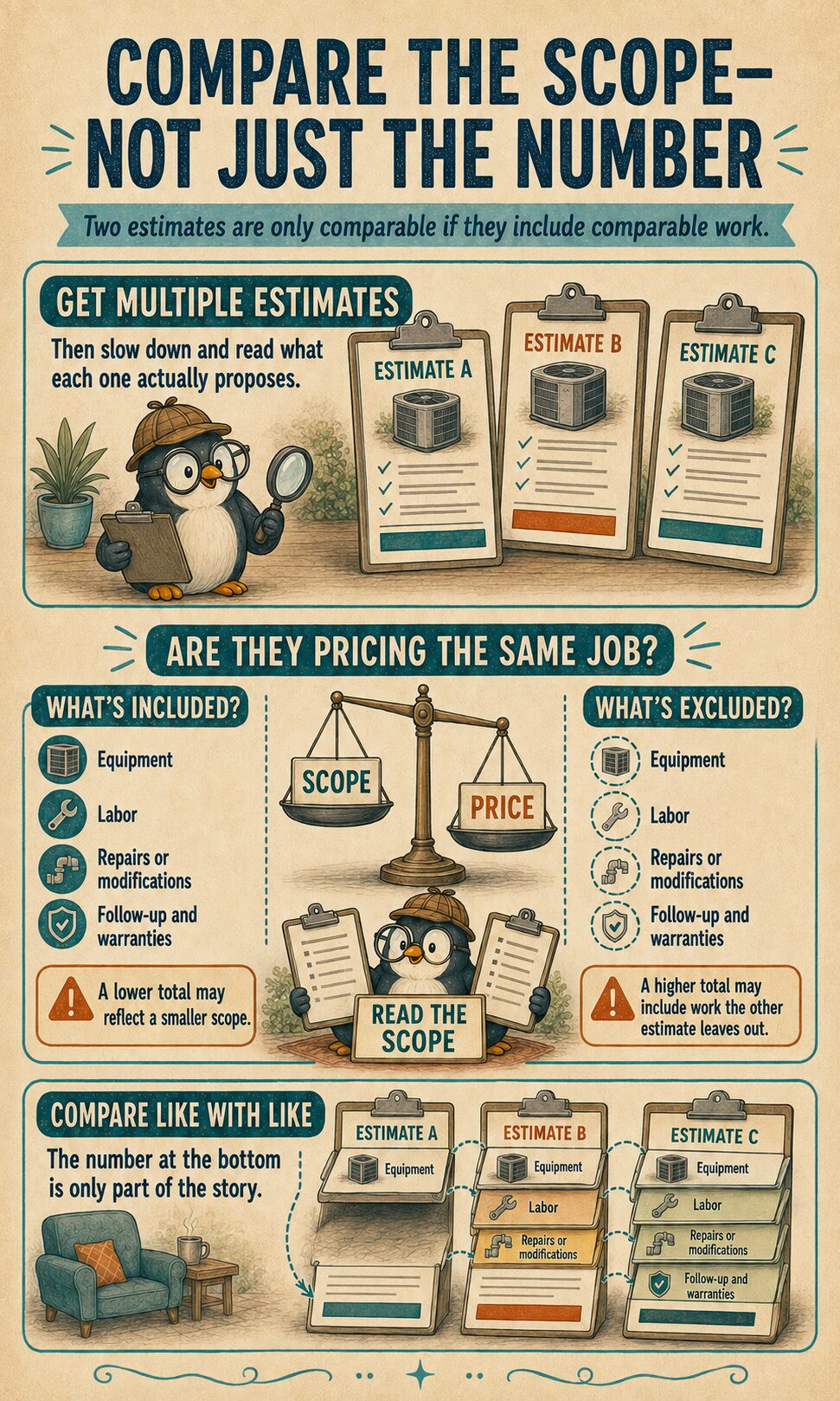
This brings us back to where we started.
Price matters. Of course it matters.
Nobody is suggesting homeowners close their eyes, hand over a credit card and whisper, “Surprise me.”
But price without context tells you very little.
If one bid is significantly lower than another, ask why.
Compare:
- Equipment size
- Equipment quality
- Efficiency
- Scope of work
- Installation requirements
- Whether ductwork is included
- Warranty coverage
- Contractor involvement and follow-through
Zuhair told us very plainly that he doesn't base his price on whatever another contractor happens to charge.
Different contractors have different equipment, costs, service models and scopes of work.
Instead, he encourages homeowners to get estimates and then understand what they're comparing.
That's a much healthier conversation than:
“This guy is $800 cheaper. Match it.”
Because cheaper may be better.
More expensive may be better.
Or neither quote may be addressing the real problem.
You don't know until you understand what's included.
The MPM Takeaway
We went into this meeting wanting better information about HVAC pricing.
We left with something more useful.
A reminder that the best vendors act like advisors before they act like salespeople.

They tell you what matters.
They explain your options.
They tell you when spending money makes sense.
They tell you when it doesn't.
They aren't threatened by questions.
They don't object to a second opinion.
And they don't have to make the other guy the villain in order to explain the value of their own work.
That's what we appreciate about Zuhair.
His confidence seems to come from knowing his business—not from needing every homeowner to say yes.
And that kind of integrity matters enormously when you're choosing someone to advise you about one of the most expensive systems in your property.
So, if we had to reduce our entire HVAC crash course to a few things worth remembering:
- Don't shut the AC completely off every time you leave for the day.
- Change your filter roughly every three months—and more often during dusty construction.
- Don't close a bunch of vents trying to redirect the system yourself.
- If the AC is blowing warm and the outdoor unit isn't operating correctly, shut it off and call for help.
- Don't assume dust means duct cleaning or one hot room means a whole new system.
- Get multiple estimates and make sure you're comparing the actual scope—not just the number at the bottom.
- Pay attention to the person giving you the advice, not only the equipment they're selling you.
Follow our Guide Below!

Because sometimes the most valuable sentence a contractor can say isn't:
“Here's what you need to buy.”
It's:
“You don't need to do that yet.”
MPM Resources is our ongoing series sharing practical information from local professionals we trust and learn from. The goal isn't to tell homeowners or tenants who to hire. It's to help them understand their properties, prevent avoidable problems and ask better questions when professional help is needed.